Your dentist has told you what to avoid: sugar, soda, ice, sticky candy.
But they’ve probably never told you what to eat. (That is, if you’re not seeing a Functional Dentist.)
The advice has only ever gone one direction.
Here are six foods that do quite a bit of heavy lifting for your teeth (and oral microbiome)…
1. Dark chocolate (85% or higher)
When I was in private practice, after every cleaning, I sent patients home with a small square of 85% dark chocolate. A dentist handing out candy. They thought I was joking. I wasn’t.
Cacao carries two compounds your teeth use directly. The first is theobromine, an alkaloid that helps enamel remineralize after acid exposure. A 2024 systematic review and meta-analysis found theobromine remineralizes enamel as effectively as fluoride in laboratory studies. Theobromine is thought to support remineralization by interacting with hydroxyapatite to form a more acid-resistant crystal structure.
The second compound is magnesium – cacao is one of the densest food sources of it, and your body uses magnesium to build enamel and bone.
At 50% cacao, dark chocolate is too high in sugar. The higher the percentage, the less sugar you’re feeding the bacteria that cause cavities, and the more theobromine you’re getting.
2. Real Bread
I know I’ve told you to avoid highly fermentable carbohydrates like bread and crackers, but hear me out…
When wild yeast and lactobacilli ferment dough for 12 to 24 hours, two things happen.
First, the starches partially break down. Sourdough’s glycemic index runs around 54 versus 70+ for white bread so you get less of a blood-sugar surge, and slower release of the carbohydrates the cavity bacteria in your mouth use as fuel.
Second, the lactobacilli acidify the dough enough that the wheat’s own phytase enzyme breaks down the phytic acid in the grain. Studies show this drops phytic acid by roughly 62% in sourdough versus 38% in yeast-leavened bread. Phytic acid normally binds the calcium, magnesium, iron, and zinc in grain and drags those minerals through your gut unabsorbed. Without it, those minerals are far more available to you.
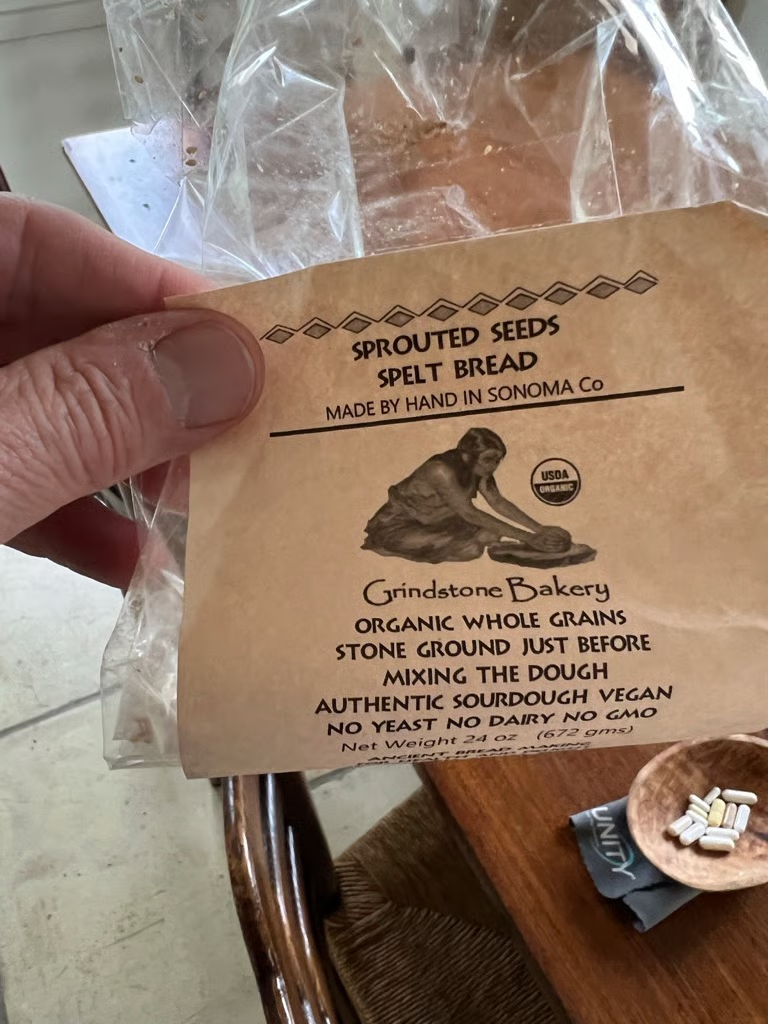
What I eat: a sprouted seeds spelt loaf, made locally, with stone-ground organic grains, naturally fermented sourdough, no commercial yeast. When I can’t get that, Ezekiel 4:9 sprouted bread is a strong second. It isn’t sourdough, but sprouting accomplishes the same thing: phytic acid breaks down, and the minerals in the grain become available to you.
Here’s what to look for at your local bakery: Bread that is slow-fermented (12+ hours), made with wild yeast or a sourdough starter (not commercial yeast), built from sprouted or stone-ground ancient grains like spelt, einkorn, or kamut, and labeled with a short ingredient list – flour, water, salt, starter. If the bag has fifteen things on it, it isn’t real sourdough, or real bread for that matter.
3. Raw cheese
In most of Europe, dinner ends with a cheese plate, not a sugary dessert. There’s a reason for that.
Cheese carries calcium and phosphate (the two main minerals your enamel is built from) and casein, the main protein in cheese, helps deliver those minerals to spots on your teeth that have been weakened. Eating cheese also raises the pH inside your mouth and keeps it elevated for roughly thirty minutes, which means the acid environment that causes cavities is being actively neutralized during that window.
I prefer raw cheese because pasteurization kills the live bacteria and enzymes that traditional cheesemaking depends on. Those bacteria help your mouth the same way the ones in fermented foods do. Raw aged cheeses are also a rich source of vitamin K2 – the vitamin that directs calcium into your teeth and bones instead of your arteries.
4. Citrus
Citrus is acidic. That much is true – and the acid temporarily softens enamel, which is why you should never brush within thirty minutes of eating it. Your saliva needs that window to re-harden the surface first.
But citrus is also the easiest food source of vitamin C, and your gums are made of collagen, which your body cannot build without it. Severe vitamin C deficiency is rare. Mild deficiency is more common than people think – especially in smokers and adults who don’t eat enough fresh produce – and it shows up as gums that are slightly inflamed, bleed too easily, and never quite heal between cleanings.
Eat the orange. Wait thirty minutes. Then brush.
5. Pickles and fermented dairy
Yes, they are acidic. That is what fermentation is – bacteria turning sugars into lactic acid (yogurt, kefir, sauerkraut, kimchi, lacto-fermented pickles) or acetic acid (vinegar pickles). pH usually lands between 3.5 and 4.5, which is why you should rinse with water after eating them and wait thirty minutes before brushing.
But fermented foods also do something almost no other food does: they put live, beneficial bacteria into your mouth. Lactobacillus and Bifidobacterium strains compete directly with Streptococcus mutans (the main bacteria responsible for cavities) and crowd them out.
Clinical studies of fermented dairy show measurable drops in S. mutans counts in people who eat them consistently. The effect is temporary, which is why fermented foods are something you eat regularly, not occasionally (in other words, snack away!)
6. Nuts
The fear with nuts is cracking a tooth. It happens, but mostly to enamel that’s already weakened.
The reason nuts belong on this list: they are one of the densest food sources of the minerals your teeth need. Almonds, Brazil nuts, and cashews are rich in phosphorus – one of the two main minerals (along with calcium) that make up enamel – and in magnesium, which is also incorporated into bone and tooth structure. Brazil nuts and cashews also carry zinc, which your gums use to heal and which many adults are short on. The fats in nuts help your body absorb the fat-soluble vitamins – A, D3, and K2 – that your teeth depend on.
Chewing hard foods helps maintain the bone that holds your teeth. Computational modeling of edentulous (toothless) mandibles suggests that as much as one-third of mandibular bone density can be lost when the jaw stops being mechanically loaded by chewing – the extreme end of what happens after tooth loss, with smaller losses expected from chronically soft diets.
In mice, a hard diet activates osteocytes and builds a stouter jawbone than a soft diet does – evidence that chewing force shapes bone. Animal studies across multiple species (rats, hyraxes, primates) show the same pattern: soft diets in early life produce narrower, shorter jaws.
Observational evidence in humans is consistent with this – children eating softer, more processed diets tend to develop narrower arches and more crowding – and it’s one of the reasons orthodontists are busier than ever nowadays.
Chew them on both sides of your mouth. Don’t crack the shell with your teeth.
Eat well, and wait 30 to 45 minutes after eating before brushing.
– Dr. B



Further Reading on AsktheDentist.com:
8 Surprising Superfoods for Your Teeth: the longer version of this list.
Phytic Acid and Dental Health: the deep dive on the mineral-blocking compound that sourdough fermentation neutralizes.
Top Vitamin K2 Foods: the other reason raw cheese matters. K2 directs calcium into your teeth and bones instead of your arteries.
What to Eat If You Have Gum Disease: the foods that help move the needle if your gums are bleeding.
Citations:
Theobromine and enamel remineralization
Sourdough glycemic response and phytic acid
Fermented foods and S. mutans
Chewing and jawbone remodeling
- Inoue et al., “Forceful mastication activates osteocytes and builds a stout jawbone.” Scientific Reports, 2019. — mouse study showing hard chewing physically remodels growing jaw architecture and the molecular mechanism (IGF-1 up, sclerostin down) behind it.
- Chou, Satpute, Müftü, Mukundan, Müftü, “Influence of mastication and edentulism on mandibular bone density.” 2013. — computational analysis of a human mandible showing that up to one-third of mandibular bone mass can be lost from insufficient mechanical loading (e.g., tooth loss).
- Sun et al., “Role of Masticatory Force in Modulating Jawbone Immunity and Bone Homeostasis: A Review.” International Journal of Molecular Sciences, 2025. — review of mastication’s effects on bone homeostasis throughout life.