By harnessing everyday clinical assessments, researchers demonstrate that personalized 12-month forecasts of cognitive and functional change in dementia can be achieved without expensive imaging or invasive testing.
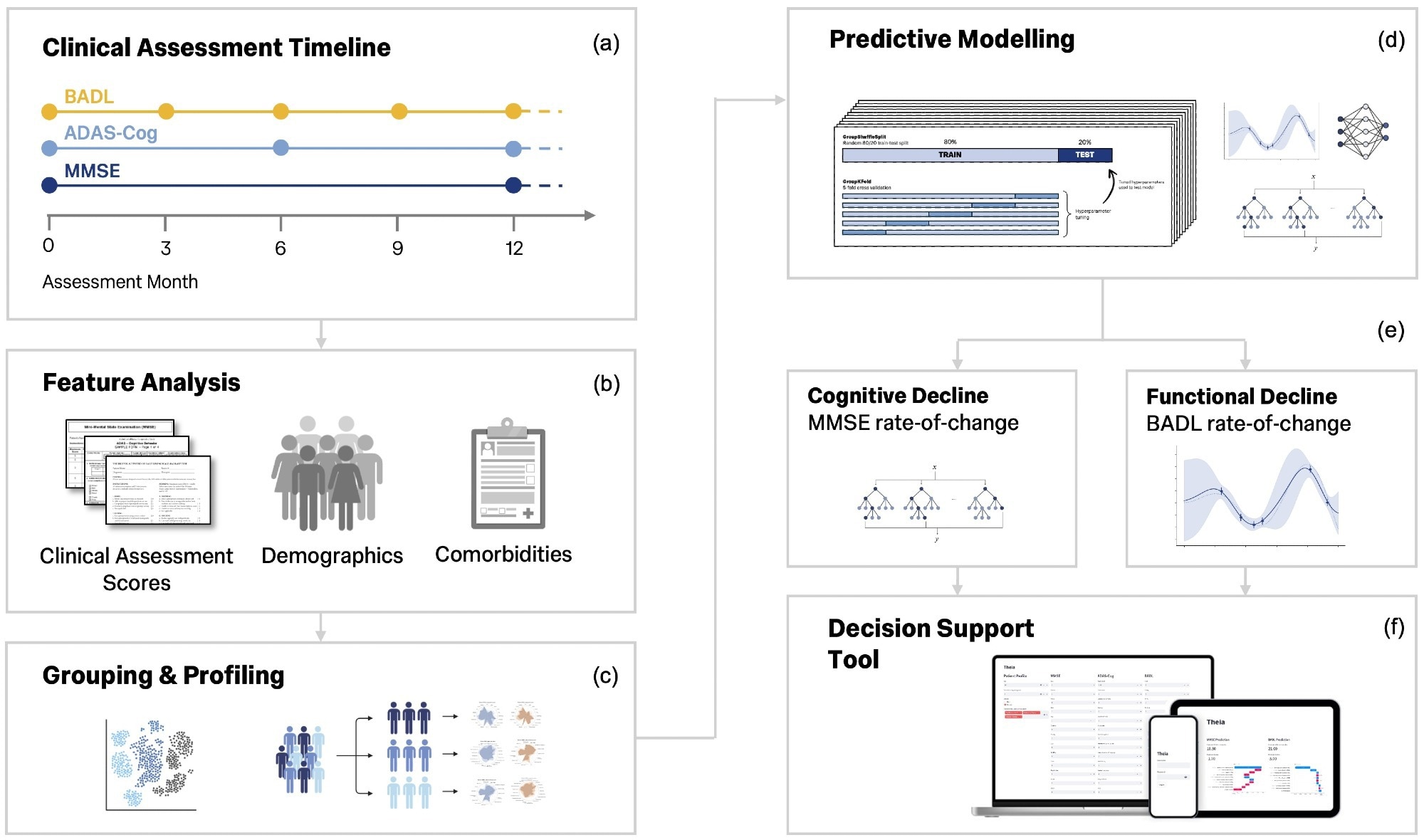

Study design and analysis pipeline. Clinical assessments are collected at regular intervals throughout the Minder study (a), features used for statistical analysis and predictive modelling included clinical assessment scores, participant demographics, and comorbidities (b), participants were first grouped based on their relative cognitive and functional decline trajectories and profiled accordingly (c), predictive models of cognitive and functional decline were fine-tuned and evaluated using a nested cross-validation approach (d), and models were selected and finalised for each outcome measure (e). Finally, a decision support tool was designed to deploy both predictive models in clinical settings (f). MMSE: Mini-mental state exam, ADAS-Cog: Alzheimer’s Disease Assessment Scale-Cognitive Subscale, BADL: Bristol Activities of Daily Living
In a recent study published in the journal Communications Medicine, a group of researchers developed and validated scalable machine learning models that predict 12-month Mini-Mental State Examination (MMSE) and Bristol Activities of Daily Living (BADL) scores, enabling individualized forecasts of cognitive and functional trajectories, in Alzheimer’s Disease (AD) and Mild Cognitive Impairment (MCI) using routinely collected clinical data.
Background and Clinical Need
Nearly 60 million people worldwide are living with dementia, and that number is expected to double by 2050. Families often ask how quickly can AD or MCI progress, as every person faces the consequences differently. Some people’s health declines fast, while others stay stable for years. Current guidelines based on average patient data often fail to capture this variability. Accurate, accessible tools that personalize predictions could transform care planning, but more research is needed to develop scalable and clinically viable prognostic models.
Study Design and Data Sources
Clinical, demographic, and medical history data were obtained from the Minder Health Management Study in the United Kingdom, an ongoing longitudinal study of people living with dementia. Researchers included only AD or MCI patients with at least 1 year of follow-up data. Each individual non-overlapping 12-month period was considered an independent clinical trajectory, an analytical assumption that treats repeated periods from the same individual as statistically independent. Across three years, 153 such 12-month trajectories were identified, of which 79 were eligible for cognitive modelling and 74 for functional modelling.
Baseline features included age, sex, comorbidities derived from Electronic Health Records using International Statistical Classification of Diseases and Related Health Problems, 10th Revision categories, and detailed sub-item scores from three assessments: the Mini-Mental State Examination (MMSE), the Alzheimer’s Disease Assessment Scale-Cognitive Subscale (ADAS-Cog), and the Bristol Activities of Daily Living (BADL).
Two ElasticNet regression models were fitted to estimate 12-month MMSE and BADL scores. Performance was estimated with nested cross-validation. They evaluated the overall accuracy of the model using three metrics: Mean Absolute Error (MAE), Mean Squared Error (MSE), and the coefficient of determination (R²). External validation of the cognitive model was performed on 741 trajectories from the Alzheimer’s Disease Neuroimaging Initiative cohort. External validation was conducted only for the MMSE model, as comparable BADL data were not available in the ADNI cohort.
Cognitive and Functional Prediction Performance
Across the Minder cohort, the average 12-month MMSE decline was -1.7 points (standard deviation 3.0), while the average BADL decline was -4.1 points (standard deviation 5.5), highlighting substantial variability in progression.
The best-performing cognitive model, based on ElasticNet regression, predicted 12-month MMSE scores with a MAE of 1.84 points (95% Cl: 1.64-2.04) and an R² of 0.74. External validation on the Alzheimer’s Disease Neuroimaging Initiative dataset yielded a comparable MAE of 2.19, despite demographic and baseline severity differences between the cohorts. Importantly, prediction error remained below the standard deviation of decline in both datasets, a comparison the authors interpret as suggesting clinically meaningful accuracy, although no formal clinical decision thresholds were predefined.
The functional model predicted 12-month BADL scores with a MAE of 3.88 points (95% Cl: 3.46-4.30) and an R² of 0.77, demonstrating similarly strong performance.
Key Predictors of Decline
Baseline total scores alone did not fully explain progression rates. Instead, specific cognitive and functional subdomains were highly predictive. For cognitive decline, lower baseline performance in ideational praxis, word recall, spoken language, word recognition, and MMSE orientation and visuospatial items strongly predicted steeper MMSE decline.
For functional decline, independence in food and drink preparation, managing finances, dressing, shopping, and engagement in hobbies were among the strongest predictors. Individuals already struggling in these domains were more likely to experience greater loss of independence over 12 months. Age was also significantly associated with a faster rate of functional decline.
Interestingly, comorbidities were not strong predictors in either model. Models performed similarly, or slightly better, without comorbidity features, particularly for functional prediction, suggesting that detailed cognitive and functional baseline patterns carried more prognostic weight than broad disease categories.
Researchers utilized Shapley Additive Explanations (SHAP) to demonstrate how each factor contributes to the result of the model, making it easier to analyze the performance of their system. These analyses indicate that the predictions are personalized for each patient based on their specific cognitive and functional profile.
Clinical Translation and Implementation
The findings indicate that it is possible to create reliable individualized predictions of dementia progression based solely on frequently collected clinical assessments without the need for neuroimaging or cerebrospinal fluid biomarkers. The team also implemented a clinician-facing decision-support tool, termed Theia, which generates predicted 12-month scores alongside SHAP-based explanations to enhance interpretability in practice. However, the relatively modest sample size used for model development and the use of research-cohort data for external validation suggest that broader multi-center validation in routine-care populations will be important before widespread deployment.
Conclusions
Using only routinely collected clinical assessments, demographic information, and medical history, two machine learning models accurately predicted 12-month MMSE and BADL outcomes in AD and MCI. The models demonstrated strong internal validity and external validation for cognitive prediction, with clinically meaningful error margins. Importantly, specific cognitive and daily living subdomains were more predictive than total scores alone. They represent highly translational, scalable, and interpretable tools. When applied in a clinical context, they can assist with individualized care planning, improve resource utilization, and provide clearer expectations to patients and their families, introducing precision forecasting into daily dementia care.
Journal reference:
- Fogel, A., Walsh, C., Fletcher-Lloyd, N., Malhotra, P., Ryten, M., Nilforooshan, R., & Barnaghi, P. (2026). Predicting rates of cognitive and functional decline in Alzheimer’s disease and mild cognitive impairment. Communications Medicine. DOI: 10.1038/s43856-026-01432-w, https://www.nature.com/articles/s43856-026-01432-w