
By Gina Jiménez, Public Health Watch
SAN ANTONIO, Texas — A Bexar County health-needs assessment published in August contains good news: The rate of mental health providers has increased by almost a third over four years, from 188 to 250 providers per 100,000 residents.
But there are stark geographic disparities: A data analysis by Public Health Watch shows that after significant growth from 2020 to 2025, mental health providers are increasingly concentrated in wealthier, northern areas. The Southside of San Antonio, in particular — the area south of U.S. 90, which has long faced health provider shortages — has barely seen any increase since 2020.
The disparity is “huge,” said Elizabeth Lutz, executive director of The Health Collaborative, a nonprofit that conducted the community needs assessment. While Bexar County has done a “phenomenal job” investing in mental health, “we still don’t have enough clinicians,” Lutz said.
Like most states, Texas has a serious shortage of mental health providers — enough to meet less than a third of its mental health needs, according to 2024 federal data published by KFF, a nonprofit research organization. Bexar County has a relatively severe shortage compared with other Texas counties, federal ratings show. The number of providers in the county — including counselors, psychologists, therapists, psychiatrists, mental health nurses and social workers — rose by more than 50%, from around 4,100 in November 2020 to over 6,200 in November 2025, according to Center for Medicare & Medicaid Services data. But while northern areas gained about 1,900 providers, southern areas added only around 150.
The disparity is striking for every type of provider. In the north, for example, about 1,100 more counselors were operating in 2025; in the south, just over 100. Nearly 250 more therapists and psychologists were located in northside offices, but only five in the south.
The per-capita rates reflect the differences: 319 providers of all types per 100,000 residents north of U.S. 90; south of the highway, 93.
The imbalance mirrors a north-south divide in median household income: $66,337 in 2023 in ZIP codes in the county below U.S.90 compared with $83,922 north of the highway. A study released in 2015 found that among large metropolitan areas, San Antonio is among the most economically segregated. Such segregation is often associated with racial and ethnic disparities as well, the study said.
“If you are poor or if you are a minority, you are going to have less immediate access to care than if you were white and living in a more affluent part of the city,”said Doug Beach, executive director of the National Alliance on Mental Illness Greater San Antonio.
People on the city’s Southside must jump through many hoops to get mental health care or simply don’t get it at all, said Sarah Stricker, a licensed professional counselor and the director of the Hill Country Crisis Counseling Program. With mental health especially, it can take a few years for patients to recognize they need help and look for treatment, Beach said. That makes the availability of services crucial. Beach recalled the case of one of his friends who struggles with severe anxiety and obsessive compulsive disorder. He was approved for a program near the South Texas Medical Center.
“He had to take three buses to get there,” Beach said. “By the time he got there, he was so frazzled, he turned around and got on the bus and went home.” The friend later found another program closer to his home.
Financial Barriers
Stephanie, who lives on the Southside, has been struggling with her daughter’s heroin addiction and mental health diagnosis since 2014. After a long, tedious process, her daughter is now receiving disability benefits, but is on a fixed income and can’t afford maintenance on a car. Stephanie and her daughter, Liza, requested that their last names be withheld to protect the family’s medical privacy.
Stephanie drives her daughter to her mental-health appointments every week, and while she is grateful for the city’s mental health resources, she wishes more providers, like the doctor who prescribes her medication, were closer.
“A lot of it is having to get in the car and drive all the way over where we need to go.”
“It’s like, ‘Where are we going?’” she said. “‘Oh, we are going up to [Loop] 1604,’ and I don’t want to drive over there.”

Stephanie, right, who lives on San Antonio’s Southside, has struggled with her daughter Liza’s mental health diagnosis for 11 years. Credit: Billy Calzada for Public Health Watch
In many Southside neighborhoods, financial risks for both patients and mental health providers impede access to care.
The needs are severe. People living in or near poverty suffer disproportionate rates of anxiety, depression, trauma and drug or alcohol addiction, years of research show. They are also more at risk of hunger, crime and living in substandard housing.
“People who live on the Southside are more stressed out,” said Amanda Fite, interim director of Jewish Family Service, a nonprofit that offers counseling in northern and southern parts of the city. “There are more systemic issues … so there is a need for mental health services.”
One in five county residents who live south of U.S. 90 don’t have health insurance, according to census data. Many can’t afford out-of-pocket costs for even basic care and often forego checkups or visits to specialists. If they’re working, they may skip their employer’s health plan because of premiums and co-pays.
The best option is Medicaid, the federal-state health insurance plan for the poor. About 23% of people in southern areas are enrolled in Medicaid, compared with 15% in the rest of the county.
But many low-income people don’t qualify, especially in Texas, which has not expanded the program to cover more adults. Nationally, Medicaid enrollment is expected to drop significantly over the next decade because of new work requirements and other changes included in the tax and spending bill signed into law last year, according to the Congressional Budget Office.
Barriers for Providers
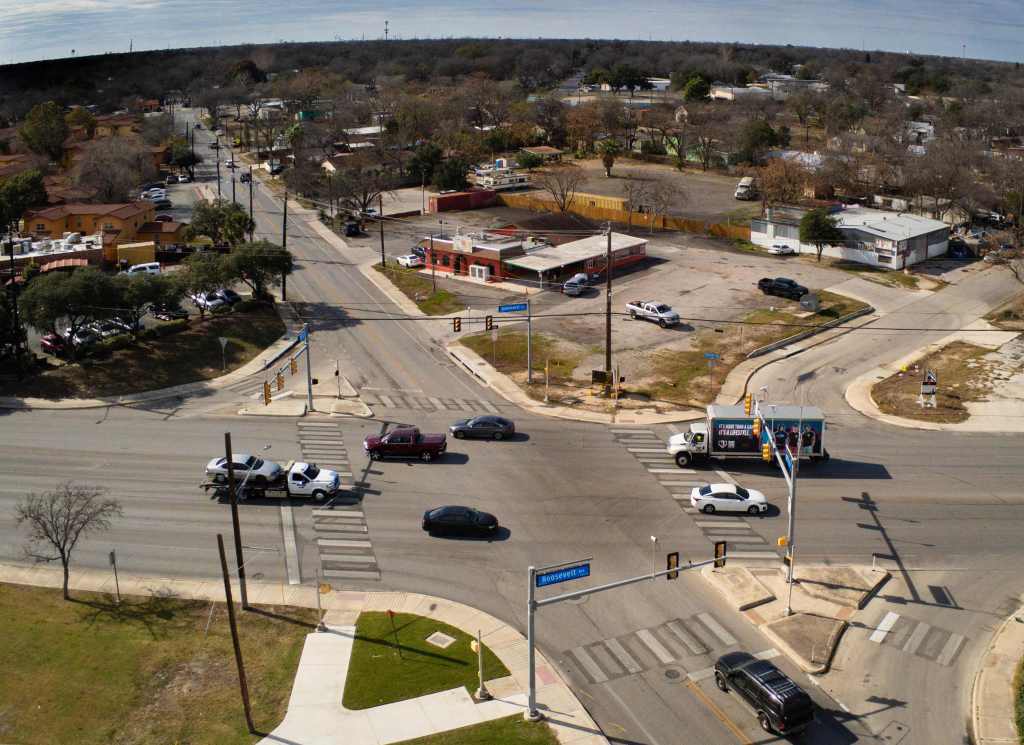
The Southside of San Antonio struggles with higher rates of people without health insurance, poverty and other factors that heighten the risk of mental illness. Credit: Billy Calzada for Public Health Watch
With more health and income risks, the Southside becomes a tougher market for private mental-health providers, who must make a profit — or, in the case of a nonprofit, a positive net income — to survive.
Some providers accept Medicaid but may limit the number of patients because reimbursement rates in Texas are relatively low. Several practitioners said Medicaid pays around $80 per session, while some private insurers pay up to $130.
Medicaid providers say they also struggle to handle government paperwork. That is the case for Diana James, a licensed professional counselor and CEO of Starlight Path Counseling on the city’s Northside. James said she wants to accept Medicaid and started the process months ago but has found it difficult to gain approval, with more requirements than with private insurers.
“It requires a lot of investment and a lot of labor and a lot of maintenance on the provider while also not getting a very high return,” Fite said.
Medicaid also doesn’t allow providers to charge no-show fees, while private insurers do. Teri Johnson, a licensed professional counselor and owner of Advance Counseling Services in San Antonio, has found her Medicaid customers have the highest no-show rates, which costs providers money. Jewish Family Service estimates its no-show rate for counseling is about 30%.
Low-income neighborhoods also have more customers who can’t afford to miss work to make a therapy appointment — many are paid by the hour — or who face transportation barriers, Stephens Stricker said. Even providers who offer telehealth, which isn’t suitable for all patients, encounter clients who have no access to reliable internet service, a personal computer or a quiet place to take their sessions, she said.
Lack of Infrastructure
Despite the problems, some providers are still looking at opening offices on the Southside. Johnson, who grew up on the Westside, realized last year that around 30% of her clients were traveling from the Southside to her northside office near the medical center for appointments. “I am amazed that they are having to travel this far to find a therapist,” she said.
She is trying to open a clinic on the Southside. She started advertising in a newspaper that serves the area, and people have called her to inquire about her services. But she said she has struggled to find office space that is properly maintained. Unlike in the medical center, her hub, there are fewer available places on the Southside.
“It’s been very difficult,” Johnson said. “The councilwoman or man for those districts needs to be made aware that businesses do want to go there.”
Eddie Reyes, a licensed professional counselor, had a similar experience when he opened his practice, 210 Counseling, in 2014.
“I found a house on the block that was available and in crazy, awful shape,” Reyes said. “Everybody was like, ‘Do not do it.’” Reyes, who grew up on the Southside, had to act as his own general contractor for nine months before he opened for business. He had to learn about city codes and obtaining permits.

The Mission Drive-In Theatre and the adjacent public library are familiar sights in South San Antonio. Credit: Billy Calzada for Public Health Watch
The Southside remains underdeveloped, with some neighborhoods lacking paved roads and having limited bus lines and spotty Wi-Fi, Rocha García said.
“If there hasn’t been investment in the streets in the area, are you really going to put [in] an investment?” said Adriana Rocha Garcia, president and CEO of the Center for Health Empowerment in South Texas. “Your employees want quality of life. They want to be able to walk to a restaurant. They want to stop at a coffee shop on their way in.”
Johnson has also found it hard to recruit therapists to work for the new location she wants to open.
Nonprofit organizations or community clinics help fill the gaps when private practitioners are scarce, but they struggle to find therapists as well.
Fite, of Jewish Family Service, said that community clinics often pay entry-level therapists around $20,000 less per year than what private practices pay. The pay gap widens for experienced staff.
University Health will open a hospital on the Southside in 2026, adding a relatively small number of mental health providers — 10 in total, including psychiatrists, therapists and others , according to data University Health shared with Public Health Watch. The health system plans to open another Southside facility in 2027, but has not indicated how many mental health providers will work there.
Reyes, the counselor, now takes most insurance, including some Medicaid plans, and maintains a full caseload — at least 30 clients a week — in order to make ends meet. He could make more money or work fewer hours if he saw only patients with private insurance, he said, but chooses not to do so.
“I enjoy the relationships and the connection that I am making, and the nurturing cycle in the community that I want to maintain,” he said. “I want to practice what I preach.”
—
 This article was originally published by Public Health Watch, a nonprofit investigative news organization. Find out more at publichealthwatch.org.
***
Join The Good Men Project as a Premium Member today.
All Premium Members get to view The Good Men Project with NO ADS. A complete list of benefits is here.
—
Photo credit: Stephanie, right, and her daughter, Liza, walk together along the Hot Wells of Bexar County Park in San Antonio on Monday, January 12. Liza requires mental health services, but has relatively few options on San Antonio’s Southside. Credit: Billy Calzada for Public Health Watch
The post San Antonio Area Sees a Boom in Mental Health Providers. But Not Where Scarcity Is Severe. appeared first on The Good Men Project.